
Our methodology is designed to answer a practical question: is this tool or approach a sensible fit for the reader’s problem, constraints and level of responsibility?
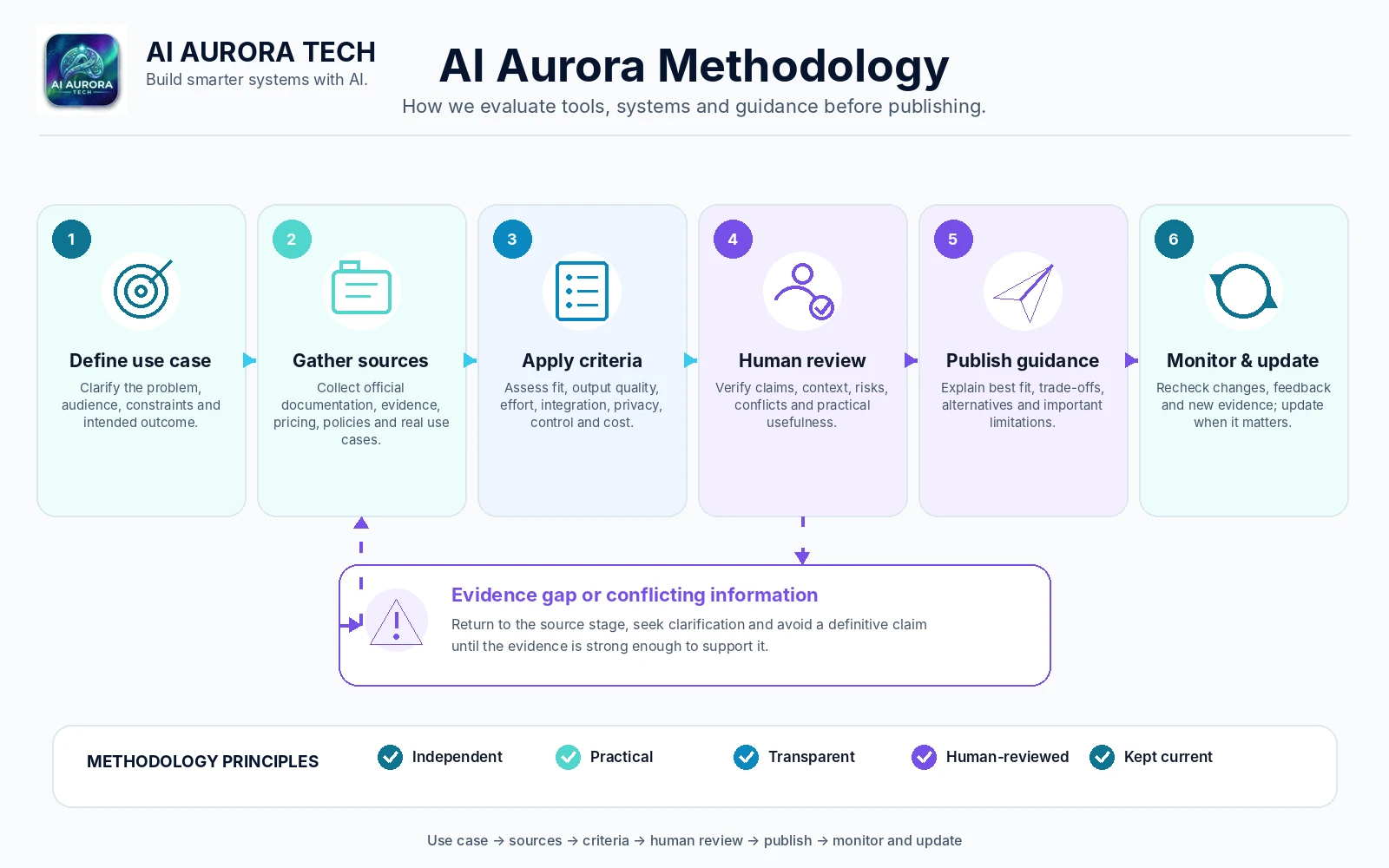
The concise version
We define the user problem, prioritise official evidence, label the level of evaluation honestly, assess meaningful trade-offs and suggest a limited pilot. We do not award confidence that the evidence does not support.
1. We begin with the decision
A product profile should do more than summarise features. Before research begins, we define the likely audience, recurring task, desired outcome and constraints that affect the decision. These may include setup effort, technical skill, data sensitivity, integration needs, operating cost, export options and the consequences of failure.
This prevents a popular or heavily marketed product from becoming the automatic recommendation. The right choice depends on the work, the operator and the controls required.
2. We use an evidence hierarchy
Material claims are checked against the strongest suitable source available at the time of review.
- Official product pages and documentation for features, availability, setup and supported use.
- Official pricing, help, trust, privacy, security and API pages for plan details, controls, limitations and technical behaviour.
- Official changelogs and release notes for recent material changes.
- Primary research or authoritative public guidance where the page makes a broader factual or regulatory statement.
- Credible independent sources for context that cannot be established from the vendor alone.
Access dates are recorded for time-sensitive evidence. Pricing, plan limits, model availability, integrations, regional access, data handling and security claims are treated as changeable rather than permanent.
3. We label the evaluation honestly
Hands-on evaluated
The product or workflow was used directly for a defined set of tasks. The page should explain the scope and limits of that evaluation rather than imply exhaustive testing.
Documentation reviewed
The assessment is based on current official documentation and suitable supporting sources. No personal-use claim is made.
Awaiting hands-on evaluation
The page provides documented decision support while making clear that practical evaluation has not yet occurred.
4. We assess the trade-offs that affect use
| Dimension | What we examine |
|---|---|
| Problem fit | Whether the product is designed for the task and audience under discussion. |
| Output and control | Quality, consistency, editability, approvals and the operator’s ability to inspect or override results. |
| Setup and operation | Learning effort, configuration, maintenance, monitoring and dependency on technical skills. |
| Integrations and exit | Connections to the wider stack, export options, portability and the cost of changing tools later. |
| Data and risk | Relevant privacy controls, permissions, retention information and consequences of incorrect output. |
| Total operating cost | Subscription price plus usage, implementation, maintenance and human-review effort. |
Not every dimension receives equal weight on every page. A lightweight writing assistant and a workflow that sends customer data into several systems do not carry the same operational risk.
5. We separate facts from editorial judgement
Features, plan limits and documented controls should be traceable to sources. Recommendations such as “best for a non-technical team” are editorial judgements based on the evidence and the use case. The page should show the reasoning and the limitations rather than present a preference as an objective fact.
We do not invent user numbers, customer quotations, test results, performance gains or internal company information. We also avoid unsupported star ratings and schema that suggests a level of review the visible page does not substantiate.
6. We recommend a pilot, not blind adoption
Where appropriate, a tool profile ends with a small pilot: a limited task, representative inputs, an owner, approval points and a success measure. A pilot should reveal whether the product fits the real workflow before a team commits more money, data or process dependency.
Updates and corrections
Product pages carry review dates because features and pricing change. Material changes are incorporated when identified and sources are rechecked during a substantive refresh. Readers can report an error through the Corrections Policy or contact page.