
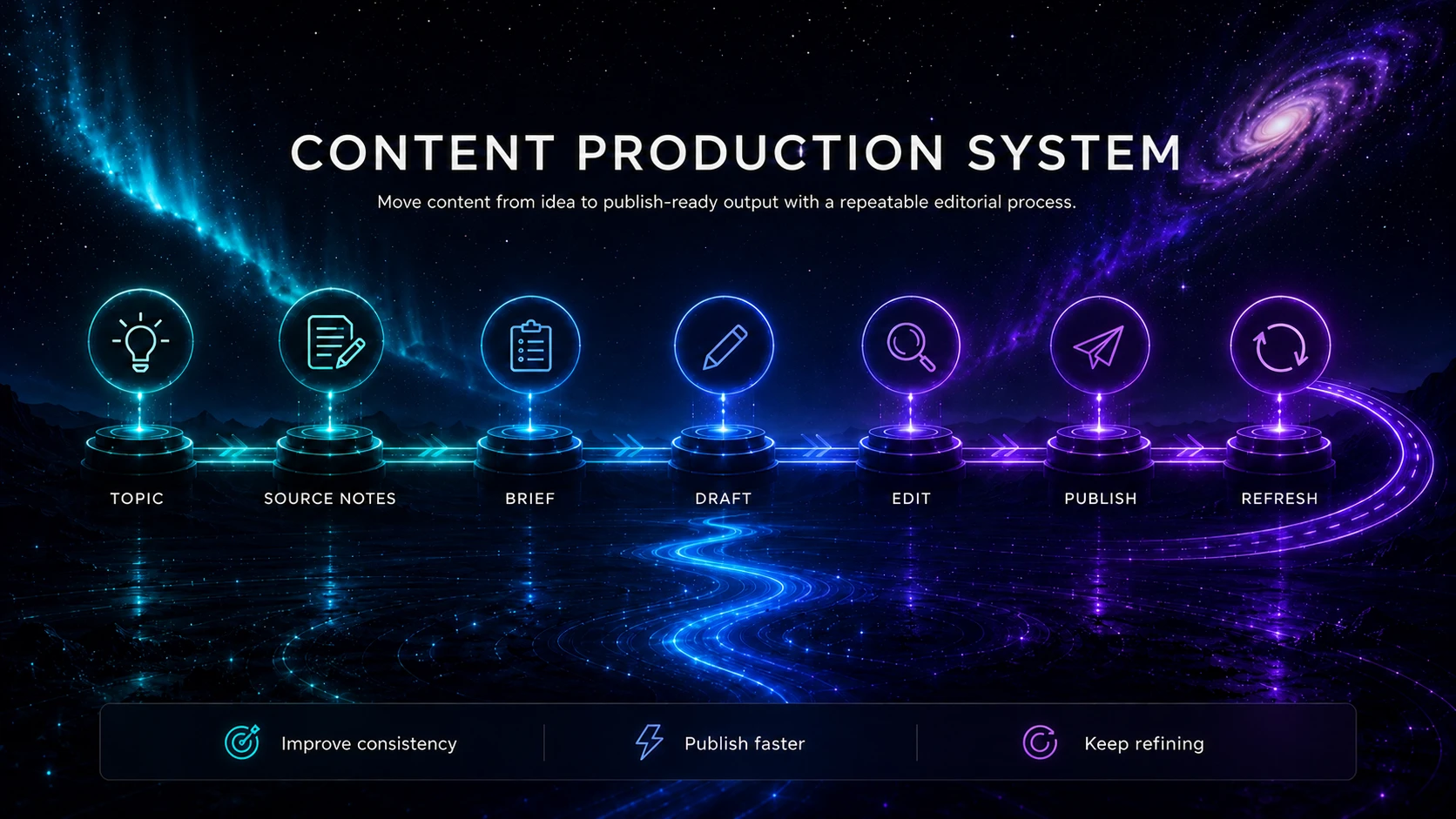
A controlled content-production system turns a validated user need and evidence record into a reviewed page, then keeps that page measurable and maintainable. It is not a machine for producing the highest possible volume of drafts.
Outcome
A publish-ready content package with a defined user need, evidence record, controlling brief, reviewed copy, approved metadata, internal links, publication owner and refresh date.
Suitable users
- Small editorial teams that repeatedly produce guides, landing pages, tool profiles or client content.
- Consultants who need consistent research, drafting and approval without losing ownership of claims.
- Operators who already have a publishing process but experience weak briefs, duplicated work or unclear review.
Trigger
The workflow begins only when a content request has an identified audience, intended decision or task, accountable owner and a reason to create or update the page.
Required inputs
- Validated user need and intended outcome.
- Existing page or content inventory result.
- Approved source list and claim record.
- Brand, editorial, legal and accessibility requirements.
- Target format, destination, owner and deadline.
- Measurement and refresh expectations.
Tool options
| Operating model | Suitable when | Important control |
|---|---|---|
| Human-operated editorial workflow | The team needs flexibility and the work is high judgement | Keep the brief, evidence record and approval log in one authoritative workspace |
| Connected document and project workflow | Briefs, drafts and reviews move repeatedly between the same systems | Automate status and hand-offs, not factual approval |
| CMS-assisted workflow | The page structure and metadata are predictable | Prevent unreviewed drafts from publishing or overwriting live content |
Process flow

- Confirm the page treatment: create, update, consolidate, redirect, defer or reject.
- Open a content record and assign the owner, audience, purpose, destination and review date.
- Build the evidence record before drafting. Separate verified facts, editorial judgement, examples and unresolved questions.
- Write the controlling brief with required sections, excluded claims, source rules, output format and acceptance criteria.
- Use AI only for bounded tasks such as organising notes, producing an outline or drafting from supplied evidence.
- Run claim-level factual review against the source record. Unsupported or time-sensitive claims are corrected, qualified or removed.
- Complete the human editorial pass for usefulness, clarity, accessibility, tone and duplication.
- Prepare the publication package: title, excerpt, metadata, canonical, social fields, internal links, image decisions and update date.
- Publish through the approved CMS process and verify the rendered page, links, images, index state and mobile presentation.
- Measure useful outcomes, record corrections and schedule refresh or consolidation.
Human approval points
- A human approves the content treatment before work begins.
- A reviewer signs off material claims and the evidence record.
- The page owner approves final language, metadata and publication.
- Legal, privacy or subject specialists review content where consequences require it.
Exception handling
- The evidence record is incomplete or sources conflict.
- A requested claim cannot be substantiated.
- The draft repeats an existing page without adding a distinct user outcome.
- A tool or policy changed after the brief was written.
- The CMS, media upload or link check fails.
- The page performs poorly because the user need or internal journey was misidentified.
Failure and fallback procedure
- Keep the content record in a review state; do not publish partial work.
- Return unsupported claims to the researcher with the exact evidence gap.
- Use the last approved copy if an AI service or integration is unavailable.
- Publish manually only when the normal CMS checks can still be completed and recorded.
- After any serious error, unpublish or correct promptly, document the incident and retest the workflow before resuming.
Approved output destination
The authoritative output is the approved CMS page plus its source record, brief, review decision and refresh date. Draft files and chat transcripts are working material, not the final record.
Owner
An editorial owner maintains the workflow, while each page has a named content owner responsible for accuracy, publication and maintenance.
Measurement
- Percentage of requests rejected or consolidated before drafting.
- Time from approved brief to publish-ready package.
- Claims returned during factual review.
- Revision rounds and avoidable rework.
- Broken-link, metadata or accessibility defects found after publication.
- Corrections, refresh completion and useful user outcomes.
Setup checklist
- Define content treatments and approval authority.
- Create a brief template and evidence-record template.
- Choose the authoritative workspace and CMS destination.
- Create standard review, metadata and publication checklists.
- Test with representative create, update and reject cases.
- Test a conflicting-source case and an unavailable-AI fallback.
- Set page ownership, correction route and refresh cadence.
Pilot sequence
- Select a small set of representative cases, including at least one incomplete input and one exception.
- Run the workflow manually while recording actual hand-offs, corrections and decisions that the documented process missed.
- Enable AI assistance for one bounded task and compare the result with the manual baseline before connecting further actions.
- Add integrations and low-risk automation one step at a time. Retest duplicate handling, permissions, alerts and manual fallback after every change.
- Review the evidence with the workflow owner and decide to adopt, revise, narrow or stop. Do not expand merely because the demonstration completed.
Operating record
Keep the current workflow definition, tool configuration, prompt version, permission decisions, test evidence, exception log, owner and review date together. A diagram or automation configuration is not sufficient on its own because it does not explain why the system is allowed to act, how a reviewer makes a decision or how the team recovers when conditions change.
Stop conditions
- Material output cannot be checked against an authoritative source.
- Exceptions or manual corrections are increasing rather than stabilising.
- The workflow creates commitments or consequential actions without meaningful approval.
- The owner, fallback route or source system is no longer available.
- Operating cost, maintenance or user burden exceeds the measured benefit.
Prompt asset specification
- Required inputs: user need, evidence record, existing-page decision, brand rules and output format.
- Master instruction: use only supplied evidence, distinguish fact from judgement and flag gaps rather than inventing detail.
- Variations: outline, source synthesis, first draft, revision brief and refresh assessment.
- Output contract: structured sections, claim flags, source mapping, unresolved questions and no invented citations.
- Human review: factual accuracy, usefulness, duplication, accessibility, metadata and publication readiness.