
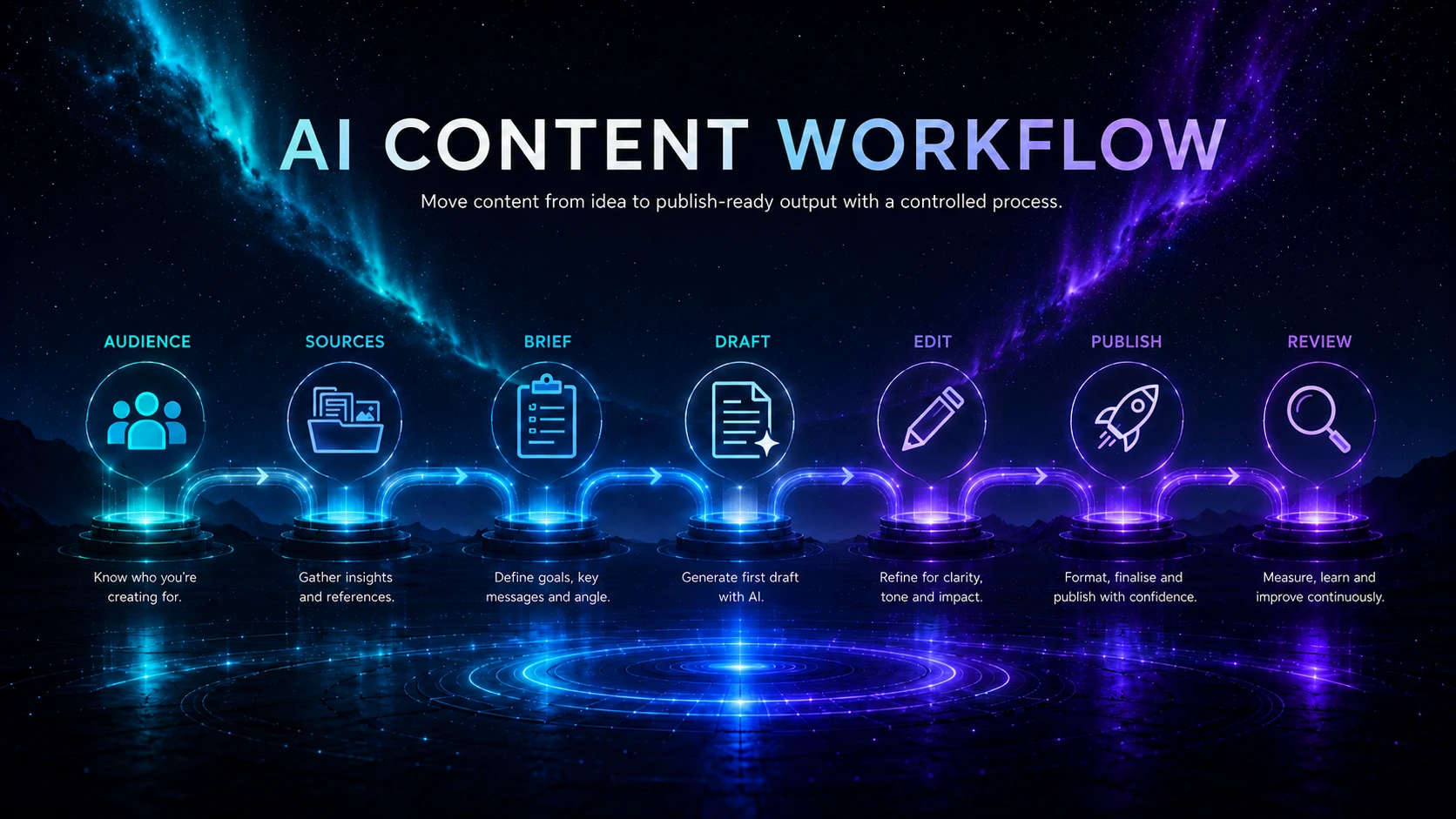
A reliable AI content workflow begins before the prompt and continues after publication. It decides whether a page deserves to exist, gathers suitable evidence, creates a controlled brief, uses AI only for appropriate assistance, applies human factual and editorial review, publishes a complete page package and monitors whether the result remains useful.
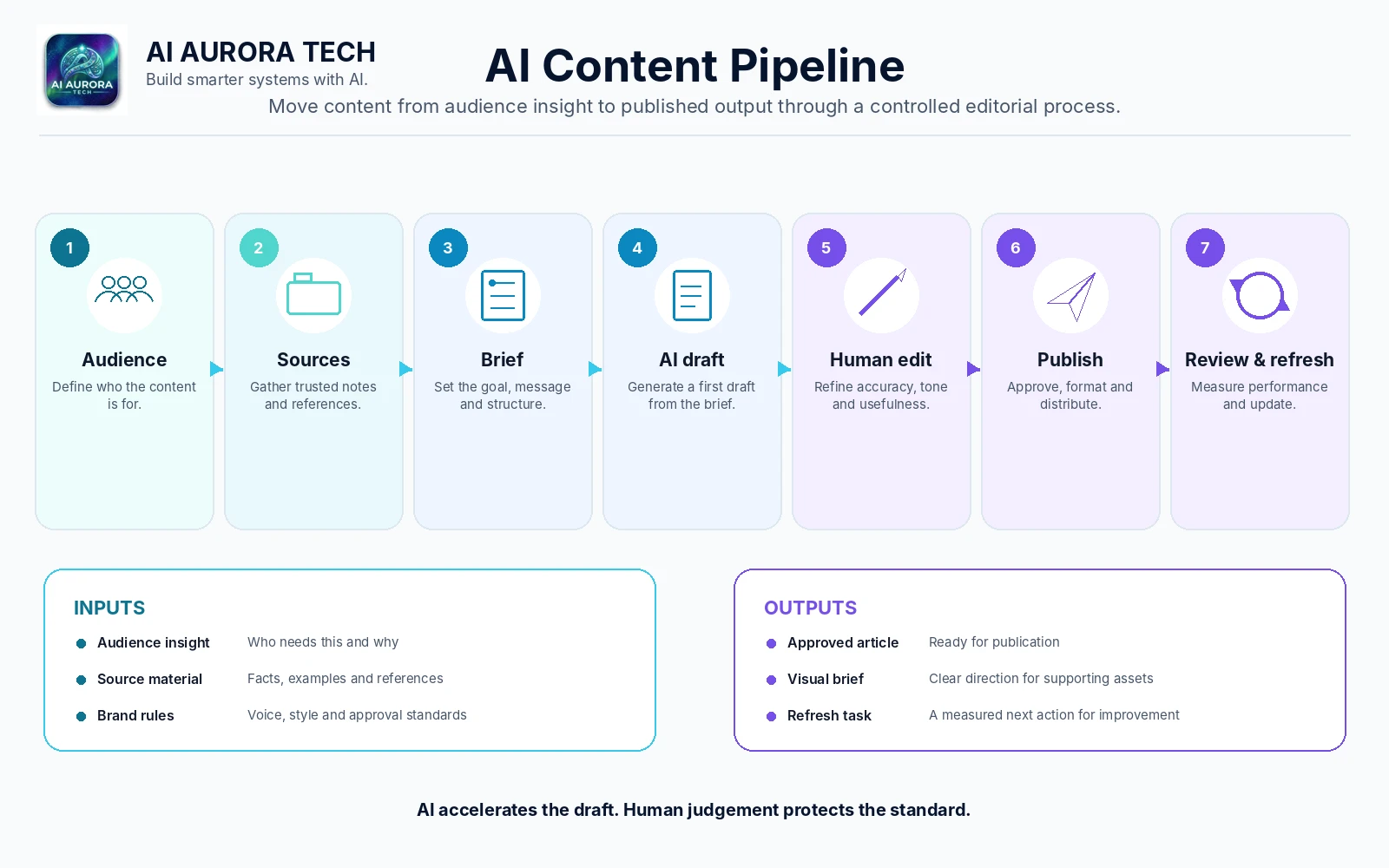
Concise answer
Build the workflow around a user need and an accountable editor. Research first, separate evidence from interpretation, define the output before drafting, review material claims at source level, publish only after accessibility and metadata checks, then measure and refresh the page. AI can assist with organisation, comparison, drafting and consistency; it cannot accept responsibility for the published result.
Who this guide is for
This guide is for publishers, consultants and small teams producing guides, tool profiles or public knowledge pages. It supports practical editorial operations rather than mass generation. Higher-impact legal, medical, financial, safety or rights-related content needs suitable specialist authority.
Key takeaways
- The first decision is whether to publish, update, consolidate or reject—not which prompt to use.
- Every page needs one user need, one primary intent owner and one useful next action.
- Material claims need source records, freshness checks and visible qualification where evidence is limited.
- A brief should control the page purpose, evidence, exclusions, structure and review standard.
- AI may organise and draft, while humans retain source interpretation, recommendations, final wording and publication.
- Judge performance by usefulness, accuracy and outcomes—not traffic or word count alone.
Jump to a section
1. Define the user need · 2. Decide the treatment · 3. Build the evidence record · 4. Write the content brief · 5. Assign human and AI roles · 6. Produce the draft · 7. Review claims · 8. Edit and check accessibility · 9. Publish the complete package · 10. Measure and refresh · Worked example · Checklist
1. Define the user need and intended outcome
Start with what a reader needs to understand, decide or do. “Write about AI note-taking” is a topic. “Help a five-person consultancy decide whether an AI meeting assistant is appropriate and what controls are required” is a user need. The second form gives the page a reader, a decision and a boundary.
| Briefing question | Useful answer |
|---|---|
| Who is the primary reader? | A defined role, situation and level of knowledge |
| What brings them to the page? | A concrete problem, decision, implementation step or uncertainty |
| What should change after reading? | They can choose, implement, improve or confidently decide not to proceed |
| What is outside scope? | Adjacent questions owned by another page, unsupported advice and future features |
| What is the next useful action? | A relevant category, guide, workflow, resource or official source |
Choose one primary reader and let related pages handle different intents.
2. Decide whether to create, update, consolidate or reject
Before drafting, compare the proposal with the existing site. Create a URL only when it owns a distinct problem; otherwise strengthen the existing intent owner.
| Decision | Use it when | Editorial consequence |
|---|---|---|
| Create | The user need is distinct and substantial enough for a complete answer | Assign a unique intent, canonical path, owner and maintenance plan |
| Update | An existing page owns the intent but is incomplete, stale or poorly structured | Preserve the record and replace weak material rather than adding a duplicate |
| Consolidate | Several pages overlap or none is individually worthwhile | Create one stronger resource and manage redirects or link changes carefully |
| Defer | Evidence, operational facts or specialist review are not ready | Keep the subject out of public navigation and avoid speculative claims |
| Reject | The page exists only for a keyword, page count or unverified promise | Do not spend maintenance effort on content without a user outcome |
A template does not make every page worthwhile
Shared structure improves consistency, but every page still needs specific research, judgement, limitations and links. Replacing names inside repeated prose creates scale without value.
3. Build the evidence and source record
Research should begin with the claims the page needs to make. Separate stable background knowledge from material facts that can change, such as product pricing, plan limits, privacy controls, availability, integrations, ownership or legal requirements.
- Prioritise primary sources: official documentation, pricing, help centres, security material, changelogs, APIs, regulations and original research.
- Record access dates: a page should reveal when volatile information was checked.
- Map claims to sources: the evidence record should show which source supports which material statement.
- Distinguish fact from judgement: recommendations and interpretations should be presented as editorial conclusions, not disguised as sourced facts.
- Preserve uncertainty: conflicting, incomplete or region-dependent evidence should be qualified rather than smoothed into certainty.
- Set freshness triggers: decide what product, policy or performance change would require a review.
Research tools can accelerate discovery, but the editor should open and assess the underlying source. A citation is not proof that the surrounding interpretation is correct.
4. Write a controlling content brief
The brief converts the user need and evidence plan into a production specification. It should be detailed enough for another competent editor to produce the same type of useful page without dictating empty length or repetitive wording.
| Brief field | What it controls |
|---|---|
| Primary intent | The one question or task the page owns |
| Audience and context | Reader knowledge, constraints and likely decision |
| Concise answer | The conclusion or orientation the page should provide early |
| Required evidence | Sources, dates and claims that need verification |
| Structure | Necessary sections, tables, examples, process or checklist |
| Exclusions | What belongs elsewhere or should not be claimed |
| Human-review level | Editorial, factual, privacy, legal or specialist checks |
| Internal links | Parent, alternatives, related implementation and next action |
| Publication package | Title, metadata, canonical, assets, status and owner |
| Maintenance trigger | Date or event that requires review |
Usefulness determines length. Specify the information needed, not a number to fill.
5. Assign human and AI roles
AI assistance is useful when its role is explicit. A model can organise supplied research, propose structures, transform formats and draft alternatives. A human remains responsible for evidence, recommendations, limitations, final wording, publication and corrections.
| Activity | Suitable AI assistance | Human responsibility |
|---|---|---|
| Research organisation | Cluster notes, compare documents and extract candidate claims | Select sources, resolve conflicts and confirm the claim is supported |
| Outlining | Propose structures against a supplied brief | Choose the sequence that best serves the reader |
| Drafting | Create a first version from controlled sources and instructions | Remove inventions, generic prose, repetition and unsupported conclusions |
| Tables and checklists | Transform verified material into a scannable format | Check categories, omissions and whether the format is genuinely useful |
| Editing | Flag inconsistency, ambiguity, duplication and style drift | Decide the final meaning, voice and level of qualification |
| Publication | No autonomous publication for material public content | Approve the complete record and accept accountability |
Do not provide sensitive or restricted information to an account or integration unless its controls, purpose and permissions have been reviewed. Data minimisation and approved source boundaries belong in the brief and prompt asset.
6. Produce a structured first draft
Draft from the evidence and brief rather than asking a model to “write an article” from general knowledge. Supply the intended audience, page purpose, approved sources, exclusions, expected structure and uncertainty rules. Require the draft to flag missing evidence instead of inventing completion.
- Prepare the source record and extract the facts that are safe to use.
- Create an outline that follows the reader’s decision or implementation sequence.
- Write the concise answer and key takeaways before expanding the detail.
- Draft one section at a time when the subject is complex or source-heavy.
- Use tables only where comparison is easier than prose.
- Add a practical example that demonstrates the framework rather than repeating it.
- Mark claims, numbers, product details and strong recommendations for human verification.
- Remove placeholders, drafting notes and unsupported links before editorial review.
Fluent language can conceal weak evidence. Treat the first draft as material to assess, not an approved review copy.
7. Perform claim-level factual review
Review material claims against their underlying sources. This is especially important for product profiles and comparisons, where pricing, features, availability and privacy terms change frequently.
- Open the source and confirm that it supports the exact wording—not merely the general topic.
- Check that the source is current, authoritative and applicable to the relevant plan, region or account type.
- Separate a vendor’s claim from independently established fact.
- Remove unsupported quantities, performance promises, customer quotations and implied hands-on experience.
- Confirm that limitations and poor-fit conditions are as specific as the strengths.
- Check names, ownership, plan labels, dates and product terminology.
- Qualify editorial inferences and explain the evidence behind the recommendation.
- Record the review date and use a correction route when a published statement later proves wrong.
For higher-impact subjects, add the required specialist review before publication. A general editorial check is not a substitute for qualified legal, medical, financial, security or accessibility assessment where the page depends on it.
8. Edit for usefulness, clarity and accessibility
Editorial review asks whether the page completes its job with the least necessary friction. GOV.UK content guidance emphasises starting with user needs, choosing the appropriate amount and format, using clear accessible language and keeping content current. Those principles are useful well beyond government publishing.
- Put the concise answer and essential context before background detail.
- Use meaningful headings in a logical hierarchy and avoid skipping levels.
- Keep paragraphs focused and define unavoidable technical terms.
- Use descriptive link text that tells the reader where the link goes.
- Give tables headers and ensure the same information is understandable without visual styling.
- Write useful alt text for informative images and leave decorative imagery out of the content flow where possible.
- Remove repetition, inflated claims, generic benefits and conclusions that add no action.
- Check UK English, brand naming, byline, dates and disclosure consistency.
Publish HTML wherever practical so users can apply browser and assistive-technology settings.
9. Publish the complete page package
Publication also includes the WordPress identity, Gutenberg structure, metadata, canonical, links, indexability, schema, assets and release controls.
| Publication check | Question |
|---|---|
| Identity | Is this the correct existing ID, slug, path, parent and status? |
| Content | Does the visible page contain the approved final wording and meaningful structure? |
| Metadata | Do the SEO title and description accurately describe the page without exaggeration? |
| Canonical | Does the canonical resolve to the intended public URL? |
| Robots and sitemap | Should the page be indexed, followed and included in the public sitemap now? |
| Internal links | Do links support the reader journey and point only to live destinations? |
| Schema | Is the selected page type supported by visible content without invented ratings or fields? |
| Assets | Are images approved, compressed, correctly described and suitable for their use? |
| Rollback | Can the release be reversed without overwriting later human edits? |
For AI-assisted public content, consider whether readers would reasonably expect an explanation of how automation contributed. The AI Use Policy should state the site-wide approach; individual disclosures are useful where the production method materially affects how readers interpret the page.
10. Measure, correct and refresh
Publication begins maintenance. Measure the intended outcome and watch for factual changes, broken links, poor search fit, unsupported claims and overlap.
- Usefulness: does the page answer the intended question and support a sensible next action?
- Accuracy: have material claims, links and operating facts remained current?
- Engagement: do readers use relevant comparisons, guides or resources rather than returning immediately to search?
- Quality signals: are corrections, support questions or internal feedback revealing unclear sections?
- Maintenance cost: is the page still worth the effort required to keep it accurate?
Refresh only when the page needs improvement. Do not change a visible review date merely to imply freshness. If two pages drift towards the same intent, consolidate them. If a page no longer solves a worthwhile problem, retire it responsibly.
Worked example: rebuilding an AI tool profile
Suppose an indexed profile describes a product but does not help the reader decide whether it fits.
- Define the need: help a small team decide whether the product fits a specific workflow and what to test before buying.
- Choose the treatment: update the retained page rather than creating a new “review” URL.
- Research: check official product, pricing, privacy and integration sources; record the access date.
- Brief: require fit, poor fit, use cases, limitations, privacy, pricing, alternatives and a pilot.
- Draft: use AI to organise verified notes and propose wording, while requiring uncertainty flags.
- Review: verify volatile claims, remove implied testing and make limitations specific.
- Publish: preserve the WordPress ID and canonical, add metadata and link to the category, selection guide and genuine alternatives.
- Improve: review when pricing, ownership, privacy controls or core product positioning changes.
The result is not merely longer: it completes a decision. Remove anything that does not help that decision.
Common failure points
| Failure | Why it happens | Correction |
|---|---|---|
| Keyword-first topic selection | The page is created to attract traffic rather than solve a separate need | Write the user need and intent owner before approving the URL |
| Source-shaped article | The draft follows the order of research notes instead of the reader’s task | Rebuild the outline around the decision or process |
| Fluent unsupported claims | AI fills gaps with plausible wording | Require claim flags and verify material statements against primary sources |
| Repeated site boilerplate | Templates are copied into every page | Move common trust information to policy pages and link to it |
| Feature-list profile | The page describes a product but does not judge fit | Add user types, limitations, alternatives and a bounded pilot |
| Publication without ownership | Nobody watches for changes or corrections | Assign an editor, review trigger and correction route |
| Scaled low-value production | Volume becomes the goal | Stop the batch, audit intent overlap and publish only pages that add value |
Content workflow checklist
- The page owns one real user need and does not duplicate another URL.
- Create, update, consolidate, defer or reject has been chosen deliberately.
- The evidence record prioritises primary sources and includes access dates.
- Material claims are mapped to supporting sources or visibly qualified.
- The brief defines audience, outcome, scope, exclusions, structure and next action.
- AI and human responsibilities are explicit.
- Factual, editorial, accessibility and specialist reviews are complete.
- The page contains no implied hands-on experience or invented results.
- Gutenberg structure, metadata, canonical, robots, schema, assets and links are checked.
- The release preserves approved IDs and has a protected rollback point.
- An owner and review trigger are recorded.
- Corrections, consolidation and retirement remain available after publication.
Official sources
- Google Search guidance on using generative AI content
- Google guidance on helpful, reliable, people-first content
- Google Search spam policies
- GOV.UK guidance on content design
- GOV.UK guidance on publishing accessible documents
- NIST AI Risk Management Framework
- NIST Generative AI Profile
- ICO AI and data-protection risk toolkit