
Use this scorecard to compare AI tools against one defined use case. It helps prevent a polished demonstration, familiar brand or low headline price from replacing evidence about fit, correction effort, integration, privacy and total operating cost.
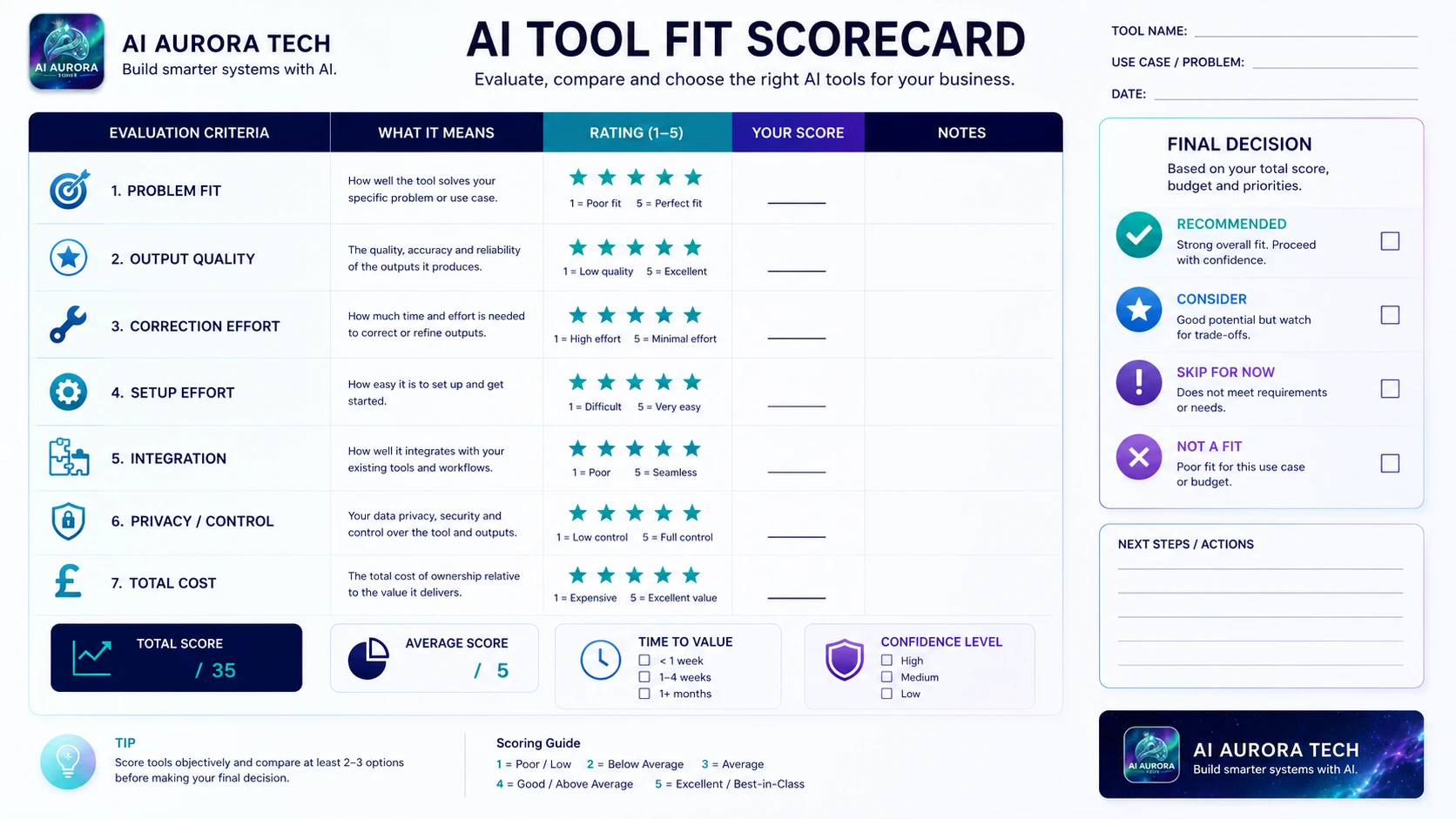
Download the scorecard
Print the landscape worksheet or complete it digitally with the people who understand the work, data and budget.
What to prepare
- One precise use case and a description of the current process.
- Two or three realistic tool options.
- Representative inputs and expected outputs.
- Privacy, integration and permission requirements.
- A monthly and annual cost estimate including setup, review and correction time.
- A person responsible for the final decision.
How to score each option
- Write the use case at the top. Do not use one scorecard for several unrelated problems.
- Rate problem fit using representative work, not the vendor’s most impressive demonstration.
- Assess output quality and correction effort together. A draft is not efficient when it creates extensive hidden review.
- Rate setup and integration based on the full operating process, including identity, permissions and destination.
- Rate privacy and control against the actual data that will be used.
- Calculate total cost beyond the subscription price. Include implementation, usage, review, training and maintenance.
- Record evidence and uncertainty in the notes column.
- Choose recommend, consider, skip for now or not a fit, then document the next action.
Interpreting the result
The total score supports a decision; it does not make one. A tool with a strong average can still fail a non-negotiable requirement. Treat privacy, required integration, export, reliability or accessibility constraints as gates where appropriate.
Use a bounded pilot
Pilot the strongest option with representative examples and a fixed review period. Record quality, revision time, failures, operating cost and user adoption. Update the scorecard with pilot evidence before committing to wider use.
Worked example
A consultant comparing tools for proposal drafting might begin with three representative discovery records and one approved proposal template. Problem fit measures whether each tool can work from the supplied evidence and structure. Output quality is assessed against completeness and factual accuracy, while correction effort records the time required to make the draft usable. Integration covers access to the document source and approved destination. Privacy and control consider client information, retention and administrative settings. Total cost includes subscription, setup, review and the time saved only after corrections. A product with the most polished first draft may still lose when it needs extensive verification or cannot fit the controlled document process.
Common scoring mistakes
- Scoring a product generally instead of scoring one use case.
- Giving output quality a high rating without recording correction effort.
- Treating a missing integration or privacy requirement as a minor average rather than a gate.
- Comparing monthly subscription prices while ignoring usage, implementation and review cost.
- Using different evidence or test cases for each option.
- Keeping a high score after the pilot reveals a material limitation.
Review and version the decision
Date the scorecard and name the decision owner. Review it after the pilot, before renewal and when the product, price, data policy or business requirement changes. Keep the earlier version so the team can distinguish a changed product from a changed use case.